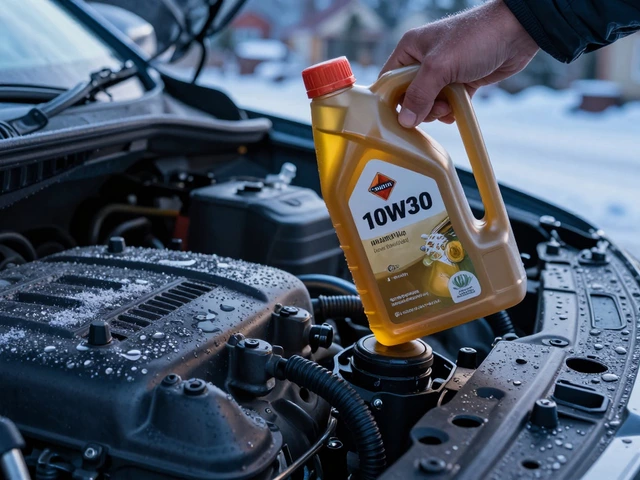
Engine Oil Selector: 5W30 vs 10W30
Answer the questions below to find the recommended oil grade for your specific situation.
You are standing in the auto parts aisle, staring at two identical-looking jugs of oil. One says 5W30, the other says 10W30. The price difference is negligible. The brand is the same. So, what gives? You might think they are interchangeable, or that one is just a slightly thicker version of the other. But pouring the wrong one can lead to sluggish starts on a cold morning or increased wear when your engine hits operating temperature. Choosing between these two grades isn't about which is "better" in a vacuum; it's about matching the fluid dynamics of the oil to the mechanical tolerances of your specific engine and the climate you live in.
The Quick Verdict: What You Need to Know
- Cold Starts: 5W30 flows faster at low temperatures, protecting engines during startup better than 10W30.
- Hot Protection: Both have similar high-temperature viscosity (the '30'), but 10W30 maintains a slightly thicker film under extreme heat stress.
- Climate Rule: If you live where winters drop below freezing, choose 5W30. If you drive in consistently hot climates with older engines, 10W30 might offer better seal protection.
- Manufacturer Priority: Always check your owner’s manual first. Deviating from the recommended grade can void warranties.
Decoding the Numbers: What Does 5W30 Actually Mean?
To make a smart choice, you need to understand what those numbers represent. It’s not just random code; it’s a standardized measurement system created by the Society of Automotive Engineers (SAE). The "W" stands for Winter. This is crucial because engine oil behaves differently depending on its temperature.
The first number (5 or 10) indicates how the oil flows when cold. Think of it like honey versus water. A lower number means the oil is thinner and flows more easily at low temperatures. When you turn your key on a frosty morning in Bristol, your engine components are dry until the oil pump circulates fluid to the camshafts and bearings. If the oil is too thick (like 10W), it takes longer to reach these critical areas, leading to metal-on-metal contact during those vital first seconds of operation. A 5W rating ensures this circulation happens quickly, even if it’s -30°C outside.
The second number (30 in both cases) represents the oil’s viscosity at normal operating temperature (usually measured at 100°C). Here, 5W30 and 10W30 are very similar. They both provide the same level of lubrication thickness once the engine is hot. However, multi-grade oils contain polymers called viscosity index improvers. These molecules stretch out as the oil heats up, preventing it from becoming too thin. While both end in "30," the base stock required to achieve that 5W cold flow is often higher quality and more expensive than the base stock used for 10W.
| Feature | 5W30 | 10W30 |
|---|---|---|
| Cold Weather Performance | Excellent (flows down to approx -30°C) | Good (flows down to approx -25°C) |
| Startup Protection | Faster circulation, less wear | Slower circulation, potential for slight wear |
| High Temp Stability | Standard protection | Slightly thicker film at peak heat |
| Fuel Efficiency | Slightly better due to lower drag | Marginal decrease in efficiency |
| Best For | Modern cars, cold climates, daily commuting | Older engines, hot climates, heavy loads |
Why Climate Dictates Your Choice
If you live in a region where winter temperatures regularly dip below freezing, the choice is almost always clear: go with 5W30. Modern engines have tighter tolerances-meaning the gaps between moving parts are microscopic. Thick oil simply cannot squeeze into these tiny spaces quickly enough when cold. Using 10W30 in sub-zero weather can result in a noisy start-up and accelerated wear on timing chains and variable valve timing actuators, which rely on precise oil pressure to function correctly.
Conversely, if you live in a perpetually warm climate, such as parts of the Middle East or southern Australia, the cold-start advantage of 5W30 matters less. In these scenarios, some drivers opt for 10W30, particularly in older vehicles. Why? Because older engines often have worn piston rings and bearings. A slightly thicker oil at operating temperature (though still rated 30, the formulation may feel heavier) can help maintain compression and reduce oil consumption. However, for most modern cars, even in hot climates, manufacturers still recommend 5W30 or even 0W20 for fuel economy reasons.

Engine Age and Wear Patterns
Your car’s mileage plays a significant role in this decision. New engines are built with precision machining that leaves little room for error. They need thin oil to lubricate tight clearances efficiently. As an engine ages, internal components wear down, creating larger gaps. This is where 10W30 sometimes finds its niche. If you have a high-mileage vehicle that burns oil or shows signs of low oil pressure, switching to 10W30 might help compensate for the wear. The slightly higher resistance to shear at startup can keep the oil pressure within safe limits for longer.
But be careful. Do not assume that "thicker is better" for old engines. If you put 10W30 in a modern turbocharged direct-injection engine, you risk starving the turbocharger of oil during cold starts. Turbochargers spin at over 100,000 RPM. They need immediate lubrication. A delay caused by thicker oil can destroy a $1,500 turbocharger in minutes. Always consider the engineering intent of the engine design before trying to "fix" wear with thicker oil.
Fuel Economy and Environmental Impact
There is a measurable difference in fuel efficiency between these two grades. Because 5W30 has lower viscosity at startup, the engine works less hard to push the oil through the system. This reduces parasitic loss-the energy wasted just keeping the oil moving. Over thousands of miles, this can translate to a small but noticeable improvement in MPG. For fleet managers or individuals driving long distances annually, using the manufacturer-recommended lower-viscosity oil can save money at the pump.
Furthermore, modern emissions systems are sensitive to oil viscosity. Thicker oils can sometimes interfere with the efficiency of catalytic converters and particulate filters, especially if the oil contains certain additive packages that are designed for thinner grades. If your car has a Diesel Particulate Filter (DPF), sticking to the exact specification (often 5W30 Low SAPS) is non-negotiable to prevent filter clogging.

Can You Mix 5W30 and 10W30?
A common question arises when topping up: can you mix them? Technically, yes. Most modern synthetic and semi-synthetic oils are compatible. Mixing 5W30 and 10W30 will result in an oil with intermediate properties. It won’t instantly damage your engine. However, it dilutes the specific performance characteristics of each grade. You lose the optimized cold-flow benefits of the 5W and the specific thermal stability of the pure 10W. It is best to stick to one grade for consistency. If you must top up in an emergency, do so, but plan to change the oil sooner rather than later to restore the correct chemical balance.
How to Choose the Right Oil for Your Vehicle
Don’t guess. Follow this simple decision tree to ensure you pick the right bottle:
- Check the Owner’s Manual: Look for the SAE viscosity chart. Manufacturers often list multiple acceptable grades based on ambient temperature ranges. If both 5W30 and 10W30 are listed, use 5W30 unless you live in a tropical zone.
- Assess Your Climate: Are you in a place with harsh winters? Prioritize the first number (5W). Is it always hot? You have more flexibility, but don’t ignore the manual.
- Evaluate Engine Condition: Is your car new or under warranty? Stick to the spec. Is it an old classic with 200,000 miles and a ticking noise? Consult a mechanic about whether 10W30 might help with noise and pressure.
- Consider Driving Habits: Do you do short city trips where the engine rarely gets fully hot? Thin oil (5W30) helps protect against moisture buildup and sludge. Do you tow heavy trailers? Ensure the oil meets the API service rating for severe duty, regardless of viscosity.
Common Myths About Engine Oil Viscosity
Let’s bust a few myths that cause unnecessary worry. First, "Thicker oil always protects better." False. Too much thickness causes drag and poor circulation, leading to overheating and wear. Second, "Synthetic oil is only for luxury cars." Not true. Synthetic blends offer better stability across temperature extremes, making them ideal for everyday cars, especially if you switch between 5W30 and 10W30. Third, "You can never switch back." You can. Engines are not locked into one viscosity forever. Switching from 10W30 back to 5W30 is perfectly fine and often beneficial after an engine rebuild or if you move to a colder climate.
Is 5W30 better than 10W30 for my car?
Generally, yes, for most modern vehicles. 5W30 offers superior cold-start protection and better fuel efficiency. 10W30 is typically reserved for older engines or extremely hot climates where the marginal gain in high-temperature film strength outweighs the cold-start penalty. Always defer to your manufacturer's recommendation.
What happens if I put 10W30 instead of 5W30?
In mild climates, you likely won't notice any immediate issues. However, in cold weather, you may experience slower oil circulation at startup, leading to increased wear on engine components. In modern engines with Variable Valve Timing (VVT), incorrect viscosity can also trigger check engine lights or cause rough idling.
Can I switch from 10W30 to 5W30?
Yes, absolutely. There is no need to flush the engine completely when switching between these close viscosities. Simply drain the old oil and replace the filter. The new 5W30 will mix with the residual oil left in the engine, and the performance will normalize after a few miles of driving.
Does 5W30 last longer than 10W30?
Viscosity grade does not determine oil life; the base oil type (synthetic vs. conventional) and additive package do. A full synthetic 5W30 and a full synthetic 10W30 will have similar drain intervals, typically 7,500 to 10,000 miles, depending on driving conditions and manufacturer guidelines.
Which oil is cheaper, 5W30 or 10W30?
10W30 is often slightly cheaper because it requires less advanced base stocks to achieve its winter rating compared to 5W30. However, the price difference is usually minimal, often just a few dollars per quart. Don't let cost dictate the choice if it compromises engine longevity.