Engine Oil Selector Tool
Select Your Vehicle
Recommended Oil Specifications
Select your vehicle details and click 'Find Recommended Oil' to see specifications.
Choosing the right engine oil isn’t just about grabbing the cheapest bottle at the garage. Put the wrong stuff in your car, and you could be looking at reduced performance, higher fuel bills, or even engine damage. The good news? It’s simpler than you think-if you know where to look.
Check Your Owner’s Manual First
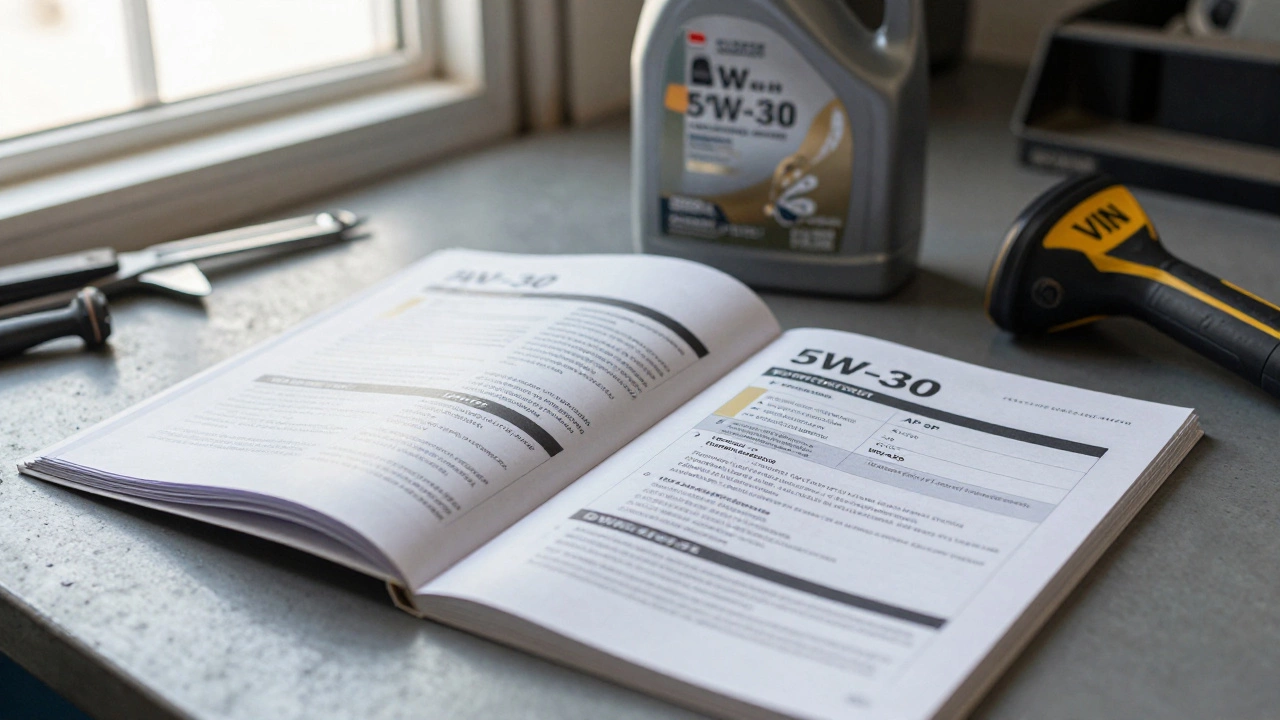
Your car’s owner’s manual is the single most reliable source for engine oil advice. It doesn’t guess. It doesn’t sell you something. It tells you exactly what the manufacturer designed the engine to use. Look for the section labeled "Maintenance," "Lubrication," or "Engine Oil Specifications." You’ll find two key details: the viscosity grade (like 5W-30) and the performance standard (like API SN or ACEA C3).Don’t rely on memory. Don’t ask the guy at the petrol station. Open the manual. If you lost it, most manufacturers let you download a digital copy from their website using your VIN number. For example, a 2023 Ford Focus in the UK typically needs 5W-30 meeting Ford’s WSS-M2C913-D specification. A 2022 Toyota Corolla might require 0W-20 with API SP. These aren’t interchangeable.
Understand Viscosity: What the Numbers Mean
Engine oil viscosity is written as two numbers, like 10W-40. The number before the "W" (winter) tells you how well the oil flows when cold. The number after tells you how thick it stays when hot. Lower numbers mean thinner oil, which flows easier in cold weather. Higher numbers mean thicker oil, which holds up better under heat and load.Modern engines use thinner oils like 0W-20 or 5W-30 because they reduce friction and improve fuel economy. Older engines, especially those with higher mileage, often need thicker oils like 10W-40 to seal gaps caused by wear. If your car has over 100,000 miles and you notice oil consumption or low oil pressure, switching to a high-mileage oil with added seal conditioners can help.
Synthetic vs. Conventional vs. High-Mileage
There are three main types of engine oil:- Conventional oil is refined from crude oil. It’s cheaper but breaks down faster and doesn’t protect as well in extreme temperatures.
- Synthetic oil is lab-made with uniform molecules. It flows better in cold starts, resists heat better, and lasts longer. Most new cars since 2015 require synthetic oil.
- High-mileage oil is synthetic or blend with additives to reduce leaks and clean sludge. It’s designed for vehicles with over 75,000 miles.
If your manual says "synthetic oil required," don’t use conventional. You’ll void your warranty and risk engine wear. Many modern engines, like the Volkswagen EA888 or BMW B48, are designed to run on full synthetic. Switching back to conventional after years of synthetic can cause sludge buildup.

Look for the Right Standards: API, ACEA, ILSAC
Oil isn’t just about thickness. It has to meet performance standards set by industry groups. The most common ones in the UK are:- API (American Petroleum Institute) - Look for SN, SP, or CK-4. SP is the latest for gasoline engines as of 2025.
- ACEA (European Automobile Manufacturers’ Association) - Common codes are A3/B4 for petrol and diesel, C3 for cars with diesel particulate filters (DPF).
- ILSAC - This is the global standard for fuel economy and emissions. GF-6 is the current rating, introduced in 2020.
If your car has a DPF (most diesel cars made after 2009), you need low-SAPS oil (low sulfur, ash, phosphorus). Using the wrong oil here can clog your filter and cost you £1,500+ to replace. Always check for ACEA C3 or C5 if you drive a diesel Volkswagen, Peugeot, or BMW.
What Happens If You Use the Wrong Oil?
Using oil that’s too thick can cause poor cold-start lubrication, leading to increased wear during those first few seconds after ignition. Too thin, and the oil film breaks down under load, causing metal-to-metal contact. Both scenarios shorten engine life.In 2024, a study by the UK’s Institute of Mechanical Engineers tracked 1,200 vehicles over three years. Those using oil one grade thicker than recommended saw a 7% drop in fuel efficiency. Those using oil that didn’t meet the manufacturer’s specification had 3.2 times more engine wear deposits after 30,000 miles.
Some drivers think "more expensive means better." That’s not always true. A £12 bottle of oil that meets your car’s specs is better than a £25 bottle that doesn’t. Always match the specification, not the price tag.
Common Mistakes and How to Avoid Them
- Mistake: Using 10W-40 because "it’s thicker, so it protects better." Fix: Stick to what’s in the manual. Modern engines need thin oil to flow quickly to critical parts.
- Mistake: Mixing synthetic and conventional oil. Fix: It won’t instantly destroy your engine, but it reduces performance and longevity. Always flush and refill with the right type.
- Mistake: Ignoring oil change intervals. Fix: Even synthetic oil breaks down over time. Most cars now have oil life monitors. If yours doesn’t, change every 10,000 miles or 12 months-whichever comes first.

What to Buy in the UK in 2025
Popular brands that meet UK standards include Shell Helix, Castrol EDGE, Mobil 1, and Total Quartz. Look for labels that clearly state:- Viscosity (e.g., 5W-30)
- API SP or ACEA C3
- Manufacturer approvals (e.g., VW 502 00, BMW LL-12)
At supermarkets like Tesco or Asda, you’ll find budget oils. They’re fine if they meet your car’s specs. At Halfords or Evans Halshaw, you’ll get premium synthetics with added detergents. Neither is better unless one matches your manual’s requirements.
When to Ask a Professional
If your car is older, has been modified, or you’re unsure about the specs, take it to a trusted mechanic. Bring your manual or a photo of the oil spec page. A good technician will cross-reference your VIN with manufacturer databases and recommend the exact oil. Don’t let them push a "premium" product unless it’s necessary.For example, if you have a 2017 Audi A4 with a 2.0 TFSI engine, the manual says 5W-30 meeting VW 504 00/507 00. That’s not the same as a 5W-30 from a different brand that doesn’t carry those approvals. The difference is in the additive package-not the base oil.
Final Rule: Match, Don’t Guess
There’s no universal "best" engine oil. The best oil for your car is the one that meets the exact specifications in your owner’s manual. It’s not about brand loyalty, price, or what your mate uses. It’s about matching viscosity, type, and performance standard. Get that right, and your engine will run smoother, last longer, and save you money on fuel and repairs.Can I use any 5W-30 oil in my car?
No. Not all 5W-30 oils are the same. Your car needs a specific performance standard like API SP, ACEA C3, or a manufacturer approval like BMW LL-04. Using a 5W-30 that doesn’t meet these specs can damage your engine or void your warranty.
Is synthetic oil worth the extra cost?
Yes-if your car requires it. Synthetic oil lasts longer, flows better in cold weather, and reduces engine wear. If your manual says "synthetic required," you’re already paying for it in fuel savings and engine protection. If your car is older and uses conventional, switching to synthetic can help clean sludge-but only if you change the oil filter too.
How often should I change my engine oil?
Most modern cars with synthetic oil need a change every 10,000 miles or 12 months. Cars with conventional oil should be changed every 5,000-7,500 miles. Always follow your car’s oil life monitor if it has one. If not, stick to the manual’s recommendation. Never go beyond 12 months, even if you drive very little.
What if I accidentally put the wrong oil in my car?
If you used the wrong viscosity (like 10W-40 instead of 5W-30), drain and replace it as soon as possible. If you used the wrong standard (like non-DPF oil in a diesel with a particulate filter), stop driving immediately and get it professionally flushed. Driving with the wrong oil for more than a few hundred miles risks permanent damage.
Do I need different oil for winter and summer?
No. Modern multi-grade oils like 5W-30 or 0W-20 are designed to work in all seasons. The "W" means they’re tested for cold starts, and the second number ensures protection at operating temperature. You don’t need to switch oils seasonally unless your car is very old or used for extreme conditions like racing or heavy towing.