Spark Plug Health Diagnostic Tool
Select the symptoms you are currently experiencing with your vehicle to analyze the likelihood of a failing ignition system.
Engine Misfires
Stumbling or jerking under load/acceleration.Rough Idle
Excessive vibration or unstable RPMs at stoplights.Poor Fuel Economy
Filling up more often despite unchanged driving habits.Hard Starting
Multiple attempts needed to start, especially when cold.High Emissions
Strong exhaust smell or failed emissions test.Check Engine Light
Light is on (often codes P0300-P0308).Knocking/Pinging
Metallic knocking sound during acceleration.Risk Assessment
Based on your inputs, here is the probability that your spark plugs are the culprit:
Select symptoms above to generate a diagnosis.
Potential Savings
Cost difference between a simple fix vs. ignoring the problem:
Your car starts. It drives. But something feels... off. Maybe it’s a slight hesitation when you step on the gas. Maybe it’s a shudder at a stoplight. You ignore it for a week, then two. Then your fuel economy drops, and the check engine light flickers on. Sound familiar? Before you panic about a blown head gasket or a failing transmission, look closer at one of the smallest but most critical components in your engine: the spark plug.
A bad spark plug doesn’t just make your ride uncomfortable; it costs you money at the pump and can lead to expensive repairs down the line. The good news? These parts are relatively cheap and easy to replace. The bad news? Ignoring the signs can turn a $50 fix into a $500 headache. So, how do you know if yours are dying? Let’s break down the seven most common symptoms of a bad spark plug, why they happen, and what you should do next.
1. Engine Misfires Under Load
This is the classic tell-tale sign. An engine misfire happens when one or more cylinders fail to ignite the air-fuel mixture properly. If your spark plug is worn out, cracked, or fouled, it can’t create the strong spark needed to ignite that mixture. The result? A stumble, a jerk, or a sudden loss of power, especially when you’re accelerating or going uphill.
You’ll feel this as a hesitation. You press the pedal, expecting smooth acceleration, but the engine stutters instead. It’s like trying to run with a pebble in your shoe-annoying and disruptive. If this happens consistently under load, your spark plugs are likely struggling to keep up. While other issues like fuel injectors can cause misfires, spark plugs are the most common culprit because they wear out over time.
2. Rough Idle and Unstable RPMs
Have you ever sat at a red light and felt your car vibrating excessively? Or noticed the tachometer needle bouncing around instead of holding steady? That’s a rough idle. When your engine is idling, it’s running at low RPMs with minimal airflow. This requires precise ignition timing. If a spark plug is weak, it causes incomplete combustion in that cylinder, leading to uneven power delivery.
This vibration isn’t just annoying; it puts extra stress on engine mounts and other components. Over time, constant rough idling can wear out these parts prematurely. If your car shakes more than usual when stopped, don’t blame the suspension first. Check your spark plugs. They might be the reason your engine is fighting to stay alive while sitting still.
3. Poor Fuel Economy
Bad spark plugs force your engine to work harder to produce the same amount of power. When the spark is weak, not all the fuel burns completely. Some of it exits through the exhaust unburned. That’s wasted money. You’ll notice you’re filling up more often, even if your driving habits haven’t changed.
Think of it like a campfire. If you have a small, weak flame, you need to keep adding wood to keep it going. A strong, hot fire burns efficiently. Similarly, fresh spark plugs ensure complete combustion, maximizing every drop of gasoline. If your MPG has dropped by 10-15% without explanation, your ignition system deserves a closer look. Replacing old plugs can often restore your fuel efficiency to its original levels.

4. Difficulty Starting the Engine
Starting your car should be quick and effortless. Turn the key (or push the button), and the engine catches within seconds. If you find yourself cranking the engine longer than usual, or if it takes multiple attempts to start, especially in cold weather, your spark plugs could be the issue.
Cold starts require a stronger spark because the air-fuel mixture is denser and harder to ignite. Worn electrodes increase the gap between them, making it harder for the voltage to jump across. If the gap is too wide, the spark may not form at all, leaving you stranded. While a bad battery or starter motor can also cause starting problems, if those components are healthy, look at the spark plugs. They’re the final link in the ignition chain.
5. Increased Exhaust Emissions
If your car fails an emissions test or smells unusually strong from the tailpipe, your spark plugs might be to blame. Incomplete combustion produces higher levels of hydrocarbons (HC) and carbon monoxide (CO). These pollutants are harmful to the environment and indicate that your engine isn’t burning fuel efficiently.
Modern cars have oxygen sensors and catalytic converters designed to manage emissions. But if the spark plugs aren’t doing their job, these systems can’t compensate fully. Over time, excess unburned fuel can contaminate the catalytic converter, leading to costly replacements. Keeping your spark plugs in good shape helps protect your entire exhaust system and keeps your emissions in check.
6. Check Engine Light Illumination
The check engine light is your car’s way of saying, “Something’s wrong.” While it can signal hundreds of different issues, spark plug problems are among the most frequent triggers. Specifically, you might see codes like P0300 (random/multiple cylinder misfire) or P0301-P0308 (specific cylinder misfire).
Don’t ignore this light. Even if the car seems to run fine, a persistent misfire can damage the catalytic converter. The unburned fuel enters the exhaust system and ignites inside the converter, overheating it and melting the internal honeycomb structure. Replacing a catalytic converter can cost thousands of dollars. Addressing the spark plug issue early saves you from this expensive repair.
7. Engine Knocking or Pinging Sounds
Do you hear a metallic knocking or pinging sound when you accelerate? This is known as pre-ignition or detonation. It happens when the air-fuel mixture ignites prematurely due to hot spots in the combustion chamber. Worn spark plugs can contribute to this by creating irregular heat patterns or failing to ignite the mixture uniformly.
Prolonged detonation can severely damage pistons, rings, and valves. It’s a serious issue that shouldn’t be ignored. While using the wrong octane fuel can also cause knocking, worn spark plugs are a common mechanical cause. If you hear this noise, pull over safely and get your engine checked immediately. Continuing to drive with knocking sounds risks catastrophic engine failure.
| Condition | Visual Sign | Common Cause | Solution |
|---|---|---|---|
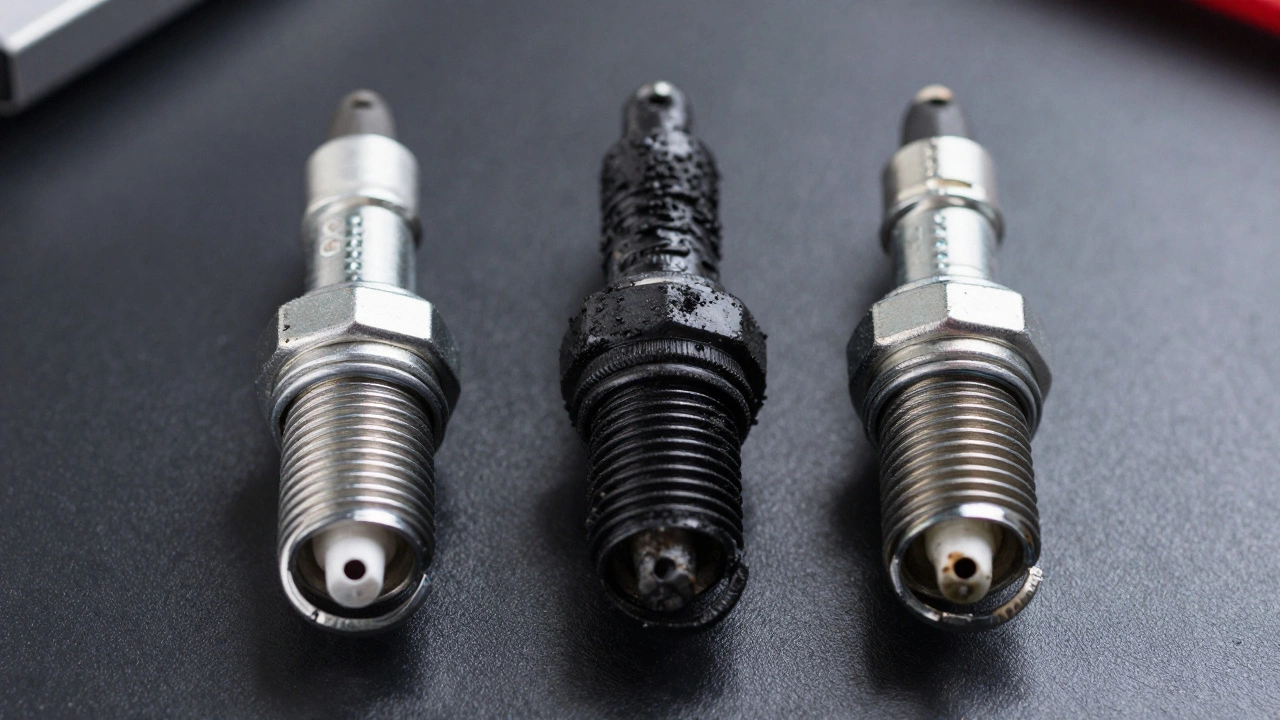
| Fouled | Black, sooty deposits | Rich fuel mixture, oil leak, or short trips | Clean or replace; check air filter and fuel injectors |
| Worn Electrodes | Eroded or rounded tips | Normal wear over time | Replace with new plugs |
| Cracked Insulator | Visible cracks in ceramic body | Heat stress or physical impact | Replace immediately; risk of misfire |
| Oil Fouling | Wet, oily residue | Valve cover gasket leak or PCV issue | Fix leak before replacing plugs |
Why Do Spark Plugs Fail?
Understanding why spark plugs fail helps you prevent future issues. The primary reasons include normal wear, fouling, and heat damage. Copper spark plugs typically last 20,000-30,000 miles, while iridium and platinum plugs can last 60,000-100,000 miles. Using the wrong type of plug for your engine can lead to premature failure.
Fouling occurs when deposits build up on the electrode, preventing a strong spark. This can happen due to a rich fuel mixture, leaking oil seals, or frequent short trips where the engine never gets hot enough to burn off residues. Heat damage, on the other hand, happens when the plug runs too hot, causing pre-ignition. This is often caused by incorrect heat range selection or engine tuning issues.
How to Diagnose and Fix Bad Spark Plugs
Diagnosing bad spark plugs usually involves a combination of symptom observation and visual inspection. Start by noting any symptoms mentioned above. Use an OBDII scanner to read trouble codes. If you see misfire codes, focus on those specific cylinders.
To visually inspect, remove the spark plugs. Look for signs of wear, fouling, or damage. Compare them to new plugs to gauge electrode erosion. If they look bad, replace them. Always replace all plugs in the set, not just one, to ensure consistent performance. Use the correct torque specification when installing new plugs to avoid damaging the threads or the plug itself.
If you’re not comfortable doing this yourself, take your car to a trusted mechanic. They can perform a compression test and ignition system analysis to confirm the diagnosis. Regular maintenance, including timely spark plug replacements, is key to keeping your engine running smoothly and efficiently.
How often should I replace my spark plugs?
Replacement intervals vary by plug material. Copper plugs should be replaced every 20,000-30,000 miles. Platinum plugs last 60,000 miles, and iridium plugs can go up to 100,000 miles. Always check your owner’s manual for the manufacturer’s recommended interval for your specific vehicle.
Can bad spark plugs damage my catalytic converter?
Yes. Unburned fuel from misfiring cylinders can enter the catalytic converter and ignite, causing excessive heat. This can melt the internal structure of the converter, leading to failure. Replacing bad spark plugs promptly prevents this costly damage.
What does a fouled spark plug look like?
A fouled spark plug typically has black, sooty deposits on the electrode and insulator. Oil fouling appears as wet, oily residue. Carbon fouling looks dry and powdery. These deposits interfere with the spark, causing misfires and poor performance.
Is it safe to drive with bad spark plugs?
It’s not recommended. Driving with bad spark plugs reduces fuel efficiency, increases emissions, and can cause engine misfires that damage the catalytic converter. Short trips might be okay, but prolonged driving risks further engine damage.
Can I clean spark plugs instead of replacing them?
In some cases, yes. If the plugs are only lightly fouled with carbon, cleaning them with a wire brush or solvent might restore performance. However, if the electrodes are worn, cracked, or heavily fouled, replacement is the only reliable solution. Modern multi-electrode plugs are difficult to clean effectively.